.png)

Someone walks up to the machine, taps their phone, and takes their coffee. Thirty seconds later they remember nothing — not the machine, not the brand, not even the fact that they paid. The transaction happened, but it left no trace in memory.
To an operator that sounds fine. A sale is a sale. But this is exactly where a quiet problem hides. If a payment stirs no emotion, the customer has no reason to seek out your machine next time. They'll come back only if they happen to be nearby and happen to be thirsty.
An ordinary payment solves exactly one task: moving the money. It's convenient, fast, invisible — and that is its weakness. The invisible isn't remembered. And what isn't remembered never becomes a habit of returning.
Choosing a machine is rarely a considered decision. A person walks past, remembers they want coffee, and buys wherever they happen to be. The next day their route is different, and the sale goes to someone else. If your machine gave them nothing to latch onto, you're not competing on quality — only on the coincidence of being nearby.
And here is where it hits the till. The bulk of vending revenue rests not on random passers-by but on the people who come back. Across the real networks we've analyzed, regular customers account for 40 to 85% of a machine's turnover (more in our article on retaining regular customers). In other words, the money is made not by new faces but by the habits of old ones.
This lines up with marketing classics. Research by Frederick Reichheld (Bain & Company) found that raising customer retention by just 5% lifts a company's profit by 25 to 95%, depending on the industry. Everyone you keep is worth more than they first appear.
Okay, you might say: my location has regulars and no alternatives — just my machine. So there is no question of winning against competitors, right?
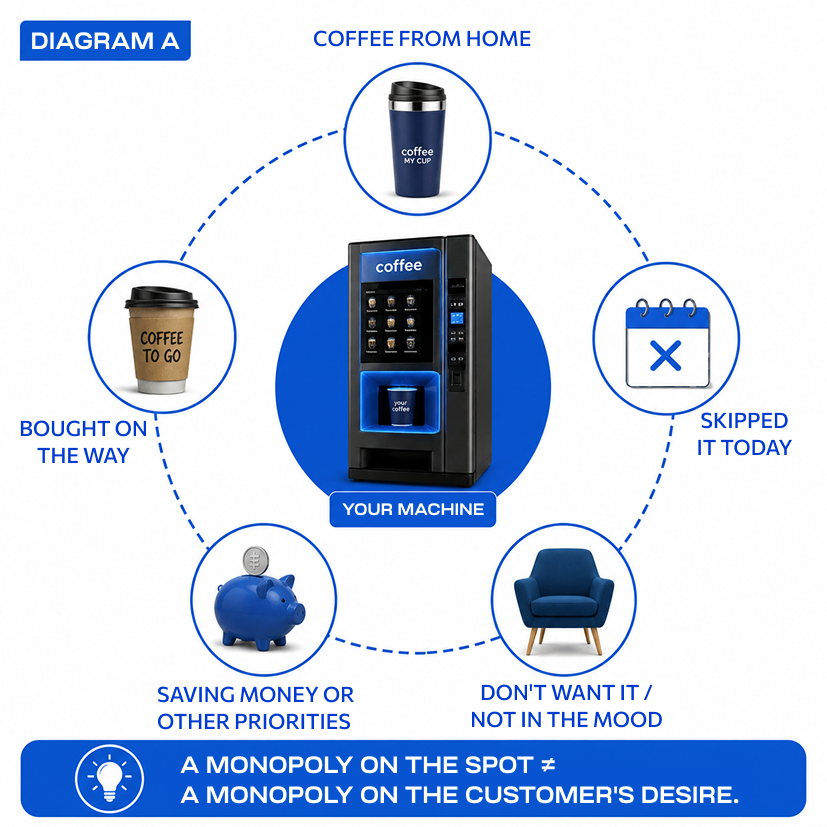
Not quite. The competitor was never just the machine across the street. The real competitor, even at a captive location, is the decision not to buy. The person brought coffee from home. Bought one on the way in. Or simply skipped it today. A monopoly on the location is not a monopoly on the customer's desire to press the button.
So even with no alternatives, you're still competing for something. For frequency: whether they buy one coffee a day or two. For whether they come back after a bad day for the machine — when it stood empty or didn't give change. An indifferent customer in that situation quietly stops using it, and you never find out why. But someone who feels something warm toward the machine forgives the glitch and comes back. That's why "the chance to be heard" turns silent churn into a signal you can actually work with.
A captive location gives you a monopoly on the spot. But not on the customer's emotion. That you'll have to earn separately.
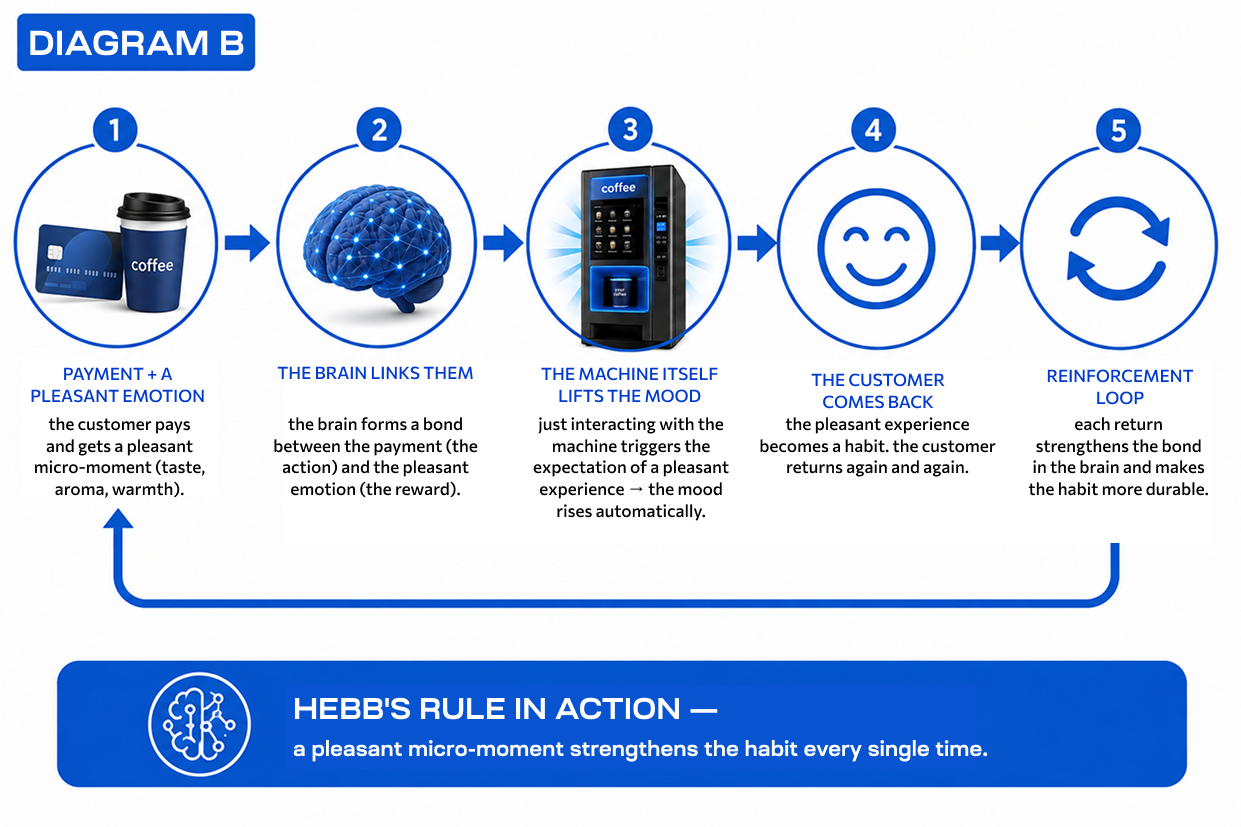
There is a principle in neuroscience usually simplified to the phrase "neurons that fire together, wire together." The exact wording came later, but the idea itself goes back to Donald Hebb in 1949. It's simple: when two experiences reliably happen at the same time, the brain begins to link them. One pulls the other along.
From there it runs automatically. If a certain action is paired again and again with a pleasant feeling, the brain fuses them into a single bundle. Next time, the trigger alone lifts your mood — before anything has even happened.
This is what the entire emotional marketing of big brands is built on. Look at how they show up at the football World Cup. They're not paying for you to see a logo. They're paying to place their product right next to your experience: a last-minute goal, the whole bar erupting, hugging strangers. The brain stitches the drink to that emotion. A month later you reach for that exact one off the shelf and don't even know why.
And this isn't just a nice theory. According to research in Harvard Business Review, an emotionally connected customer is on average 52% more valuable than a merely satisfied one: they buy more often, haggle less over price, and recommend you more readily. When one bank launched a card designed specifically for an emotional connection with younger users, usage rose 70% and new accounts grew 40%.
In vending it's far simpler and cheaper. You don't need a World Cup. You need one pleasant micro-moment at the second of payment. If pressing the button delivers a small spark every time, the machine stops being a metal box that sells coffee. It becomes a place where something good happens every day. And the customer's brain remembers it for you.
The theory is clear. From there, the team and I brainstormed a bit about how, exactly, to pack that pleasant emotion into the second of payment. Here are the mechanics that genuinely warm the customer while changing nothing in the machine itself.
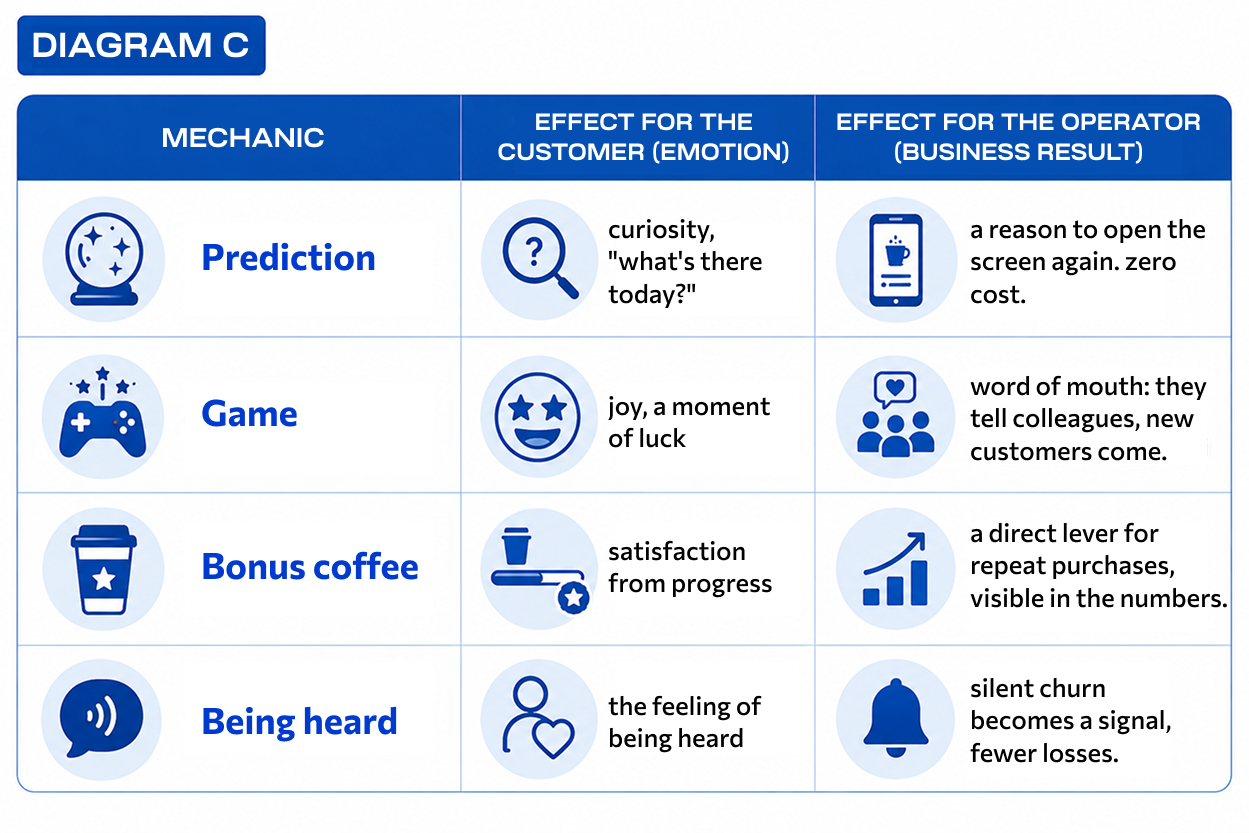
A prediction. After paying, the customer gets a small wish or a forecast for the day. A trifle — but it switches on curiosity: what will today's say? It's pleasant for the customer, costs the operator nothing, and gives a reason to open the payment screen again just out of interest.
A game. Payment turns into a small event with a hint of luck. Spin, win, smile. That's the same pleasant micro-moment the brain will tie to the machine. A routine purchase becomes something worth mentioning to a colleague — and what gets talked about brings in new people for free.
A bonus coffee. Classic loyalty, but it works on two levels at once. Rationally: every purchase brings the free one closer. Emotionally: watching the progress bar fill up is pleasant in itself. For the operator it's the most direct lever for repeat purchases, and it shows up in the numbers.
The chance to be heard. The customer can say the coffee was bitter today or the machine ate their change. And the point isn't the complaint itself. The point is the feeling of being heard. Remember the indifferent customer who quietly disappears after a glitch? This is the mechanic that turns that silent churn into a signal. The customer stays, and the operator finally sees what is actually happening at the machine.
Picture a machine in an office building. The same crowd every day — and it's exactly these regulars that revenue rests on. One of them quietly stopped buying coffee after the machine ate their change. With a "be heard" mechanic, they'd have typed it right on the payment screen, gotten a reply, and stayed. Instead, the operator simply lost a regular and never learned why.
Beyond these four, we sketched more ideas aimed at the same feeling. A melody that plays at the moment of payment. A short "enjoy!" from the machine after it dispenses. A seasonal payment-screen theme for the holidays. An occasional "lucky" receipt with a mini-surprise. Each is the same micro-moment of warmth, just in a different wrapper.
And this isn't guesswork. Back in 1982, a classic study in the Journal of Marketing showed that even the tempo of background music on a sales floor shifted a supermarket's revenue by nearly 40%. One well-timed cue at the right second really does move behavior — and the second of payment is perfect for it.
Each gesture on its own is small. Together they make payment feel warm — and make the machine one people want to come back to.
All these mechanics sound charming on paper. But they only work on one condition: the customer shouldn't have to install anything, register, or remember anything. The warmth has to be right where the person already is — in the payment moment itself.
That's why at ProstoPay we didn't build yet another "pay" button — we built a platform around it. Web payment opens with no app and no separate POS terminal, and it's the one point every customer passes through. Which makes it the best possible place to add emotion.
Loyalty was the first thing to move in (more: loyalty programs in vending). A bonus coffee, progress, a reason to return. And it's not theory: by our analytics on live projects, loyalty delivers roughly +15% purchases. The emotion invested in payment comes back as a number in the till.
Now we've taken the next step and built "Prediction" into that same payment. Not a separate service, but part of the familiar payment screen. The customer pays as usual and gets a small moment of a smile in return. That's how a plain transaction becomes an emotional one: the customer didn't just settle up — they felt something.
Science backs this up too. Studies of gamified loyalty programs show a consistent pattern: game elements raise engagement, and engagement in turn drives repeat purchases.
The idea here isn't to "entertain for entertainment's sake." It's to turn the very second when the customer is already looking at the screen into a brick in that same bond with the machine — the one Hebb wrote about.
You don't need to rebuild your business for customers to start coming back more often. This whole article boils down to one simple thought: people return to where they once felt good. An indifferent payment leaves no such trace.
And you can start small. Pick the one mechanic that resonates with you most. The bonus coffee, if you want to see the effect in numbers right away. A game or a prediction, if you want emotion. The chance to be heard, if you're tired of losing customers in silence. One is enough to make the machine stop being just a metal box on the corner.
After that, the customer does the rest themselves. Because their brain is already wired to return to where things went well. Your job is only to give them that reason once.
Want to test it on your own machine? We'll switch on one mechanic and look at the repeat-purchase numbers together.


