.png)

You found the location. You installed the machine. You crossed your fingers and hoped the effort would pay off.
Within three or four weeks, a month at most, the point tells you how many people are buying and what revenue will hold. That number is not pulled out of thin air. It shows up exactly when the novelty of the machine wears off and only the people who come back remain.
By our research, repeat customers deliver from 40% to 85% of a point's revenue, depending on the location. On a median location that is around 70%. The more closed the location, the higher the share. In an office or a factory, people walk past the machine every day. At a train station, most people see it once in their lives.
And that is the whole point. A machine does not live off the first purchase of a random passerby. It lives off the tenth purchase from the same customer. The math was worked out long ago outside vending and published in Harvard Business Review: acquiring a new customer costs 5 to 25 times more than retaining an existing one. And selling to someone who has already bought is far easier. The probability of a sale to an existing customer is 60 to 70%, to a new one only 5 to 20%.
So the question is not how to bring more new people to the machine. The question is how to bring back the ones who already bought. In this article we break down what actually drives that, and how a loyalty program fits into the bigger picture.
Short answer: not cold calculation, and not love for your coffee. A return is habit plus emotion.
Research by Wendy Wood at USC showed that about 43% of what a person does in a day is repeated automatically, with almost no thought. The mechanism is simple.
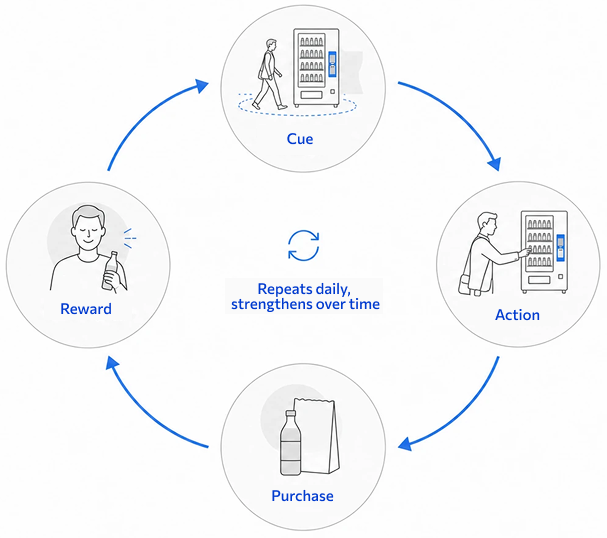
There is a context cue, there is a reward for responding to it, and with repetition the action becomes automatic. The machine in the office corridor is exactly that cue. A person walks past it every day at the same time, and their hand reaches for the machine before conscious choice even kicks in.
Almost everything else follows from this.
Location and habit are one thing. A habit attaches not to a brand but to a place. Wood found that behavior repeats on autopilot in the same location, and the space itself seems to "remember" for the person. This is clearest in reverse. Students who regularly went to the gym on the old campus often quit after moving, even when the new gym is closer and better. The cue disappeared, the habit fell apart. So a closed location with a steady flow of the same people produces repeat customers, and a high-traffic pass-through point does not. This is not about machine quality. It is about the repeatability of the context.
Here is where what Byron Sharp calls physical availability comes into play. A brand grows not when people love it, but when it is easy to notice and easy to buy at the moment of need. In vending, physical availability decides almost everything, because the purchase is impulsive and happens on the spot. The machine has to be on the person's path, working, holding change, accepting payment without failures. Every failure is a break in the habit.
Payment convenience is not a service. It is part of the habit. A habit is a sequence without friction. If halfway through that sequence a person hits the need to dig for coins or watches a payment fail, the chain breaks. One failed tap teaches a person to walk past next time. Contactless removes exactly this friction. Payment in a second does not force the conscious mind to switch on, and the habit stays intact.
A stable assortment holds the habit. Variety kills it. This is counterintuitive, but Wood shows it plainly: habits do not like variety, it weakens their force. A person comes back for a specific item. If their favorite coffee or snack is missing today, it is not just this one purchase that is lost, but the pattern itself. An empty slot where the usual product should be costs more than it looks.
The purchase itself is emotional, not calculated. In "Thinking, Fast and Slow" Kahneman described two modes of thinking. Fast, automatic, emotional. And slow, analytical. Most decisions a person makes with the first mode, fast and unconscious, not with conscious calculation. Buying a snack by the elevator is pure System 1. Nobody calculates the price per gram. The person wants a small reward here and now and takes it.
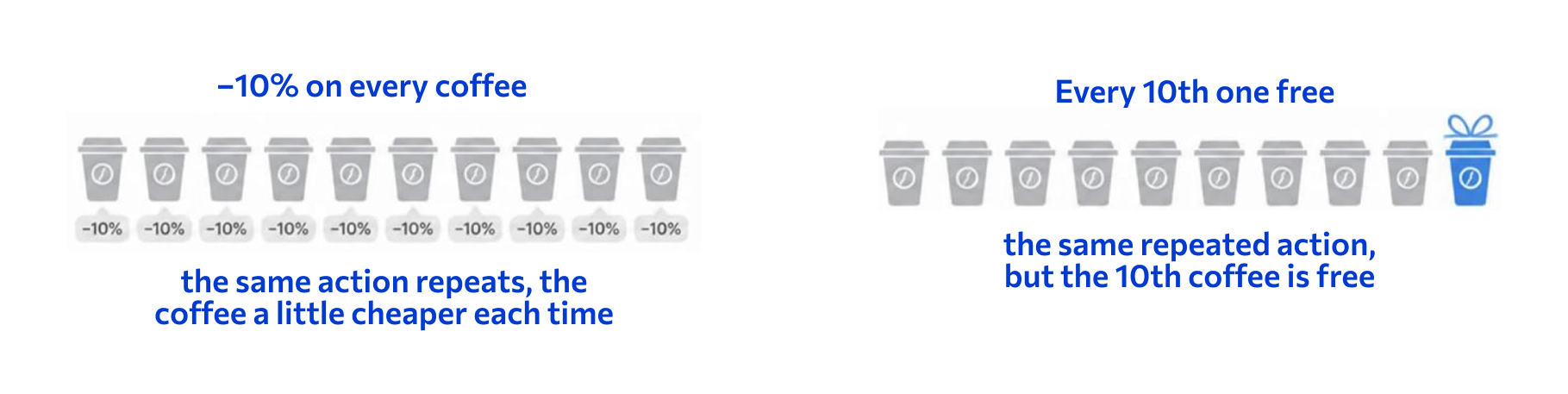
Hence the irrationality that all loyalty rests on. In "Predictably Irrational" Dan Ariely showed that people define value not in absolute terms but in context. And that free carries such an emotional charge that an offer feels far more valuable than it is. A free coffee after nine bought ones costs the operator pennies. Rationally it is a discount of about 10%. Emotionally it is a gift. The brain counts these two things differently, and that is exactly why a gift works better than a discount of the same amount.
The same place holds one more bias. People overvalue what they already own. Collected points or progress toward a free item create a feeling nobody wants to lose. This keeps a person in the system even when the cold reasons to stay are gone.
And a final touch, the moment it ends. Kahneman described the peak-end rule.
An experience is remembered by its most intense moment and by how it ended.
A pleasant, unexpected bonus at the end weighs disproportionately much. It colors the entire memory of the machine, and it is that memory the person carries back next time.
Price is also judged by System 1, not by a calculator. A repeat customer rarely compares prices every day. They hold a reference for a fair price in their head and notice when it is suddenly broken. A stable, predictable price supports the habit. A sharp jump knocks the person out of autopilot and makes them think, and thinking is an exit from the habit.
The summary is simple. A return rests on three things. A habit tied to a place. The absence of friction at every point of contact. And emotion at the moment of purchase, which is almost always irrational. The loyalty program we move to next hits all three at once. It feeds the habit with a reward, removes friction through payment, and delivers that same irrational joy of "free."
Now to the levers an operator actually controls. There are not many, and they are not equal.
Availability. The base lever, without which the rest is meaningless. This is what we called physical availability in section 2: how easily a passerby can become a buyer right now. The machine has to be close, on the person's route, not one floor up. The menu has to read at a glance, because every second of hesitation is friction. There has to be basic trust that the machine works, will not eat money, and will dispense the product. And payment has to be accessible, because a cash-only machine quietly cuts off everyone without small change, and most people do not have it.
Reliability. The quietest lever and the most underrated. One empty slot where the favorite item should be, stuck change, or a machine that is down in the morning does not cost a single purchase. It breaks the habit, and a habit does not always recover after a break. The person walked past once and bought at the shop next door. Reliability is the share of successful payments, product availability, and a working machine at every moment. Managing this by hand at scale is impossible. This is exactly where telemetry works. It shows the operator remotely what is running low, what broke, and where sales are dipping, before the customer even notices. Reliability attracts no one. Its absence scares off everyone.
Price. The subtlest lever of the four, because it works both ways. Driving the price down for the sake of loyalty is the worst option. It cuts margin and builds no habit. A repeat customer, as we saw, reacts not to cheapness but to fairness and predictability. So price retains not when it is low, but when it is stable and clear.
From here a couple of working moves. Keep the price predictable: the customer should pay each day what they expect, with no unpleasant surprises. Make the price easy to read: an even, easily grasped number registers without effort and adds no friction to the decision.
Loyalty programs. The three levers above are defensive. They remove reasons to leave. A good loyalty program gives a reason to come back more often and to choose your machine specifically. It is the only mechanic that hits directly at the emotion and irrationality from the previous section. A reward for the habit. Reluctance to lose what has been collected. The irrational joy of "free." The rest of the levers hold the current level. Loyalty raises it.
First a clarification. A loyalty program is a broad concept covering many different mechanics. They have different economics and different psychology. We break down four types in turn, with the pros and cons specifically for vending.
Discount for a repeat customer. The simplest format. A permanent price lower than the regular one.
Pro: instant and clear, nothing to accumulate. Con: it hits margin from the very first purchase. And it stops working psychologically fast. A permanent discount becomes the new normal, the reference price shifts, and the gift no longer feels like a gift. For vending with its small ticket, this is the weakest lever. A few saved hryvnias build no habit.
Cashback or points. Part of the sum returns to the customer's balance.
Pro: "money back" is psychologically more pleasant than a discount of the same size, because it creates a small asset you want to come back to. Con: in vending the ticket is small, so cashback is measured in pennies, and its emotional charge is weak. It also costs margin and is harder to explain. A middling option. Emotionally better than a discount, but the sums are too small to retain.
Cup collection. Accumulation per purchase, the classic "buy nine coffees, the tenth is free."
This is the strongest format specifically for vending, because it hits all three psychological levers at once. Progress toward a goal motivates. What has been collected you do not want to lose. Collected cups bring the customer back even when a competitor next door is cheaper. That is pure loss aversion. And the "free tenth" delivers the same free effect, which rationally is a 10% discount and emotionally a gift.
There is a con here too, and it is worth stating honestly. A share of points always expires unused. For the operator this is a double-edged stick. On one side it is a saving, because not all rewards are redeemed. On the other it is a risk, because a high share of unused bonuses is a signal that the customer sees no value in the program. So the mechanic has to be simple and the balance always visible. One more nuance: points require customer identification, meaning a card, an app, or a link to a phone number. Without that, accumulation does not exist.
Subscription or bundles. A prepaid format, roughly "30 coffees a month for a fixed sum."
Pro: the strongest retention of all types. The reason is that the person committed in advance. Subscription models deliver 60 to 85% annual retention against 20 to 35% in regular transactional trade. Plus it is predictable revenue for the operator. Con: a high entry threshold for an impulse purchase. A subscription works only on very habitual locations, where a person drinks coffee every day in the same place, for example in an office. At a pass-through point nobody will buy it. A niche format, but powerful on the right location.
Pull it all together and the picture for vending looks like this. A small ticket and high purchase frequency make cup collection the most universal format for most points, and subscription the strongest for the most closed locations. Discount and cashback lose, because they cut margin without giving either an accumulation effect or the sense of a gift.
Having understood that a loyalty program will help our partners earn more, we decided, after careful research, to launch a new product and implement one of these mechanics directly on web payment. For now free for all operators.
The mechanic is simple. The customer pays for a drink the way they always have. They point the camera at a QR code or tap the phone to the NFC sticker on the machine's payment label. The payment goes through, and the purchase is automatically added to the count. Once enough of them accumulate, the next drink is free. The threshold at which the free item triggers is set by the operator to fit their own economics and location.
Now to the decision that sets this approach apart. The main downside of points: they require customer identification, meaning a card or an app. And that is friction, and it is exactly where most loyalty programs die. A person does not want to download an app for a coffee and does not carry a plastic card from a machine.
Loyalty from ProstoPay is built straight into the payment, not spun off into a separate app or card. The phone the person already pays with is their loyalty account. Nothing to download, carry, or forget at home. Accumulation happens on its own, inside an action the customer is already performing.
And this is where all the psychology from the previous sections comes together. Payment in a second does not break the habit, and now it also feeds it with a reward. Progress toward the free item is visible, and you do not want to lose it. That is the same loss aversion. And the free drink delivers the "gift" effect, which rationally is an ordinary discount and emotionally means far more. The program does not fight the customer's habit or interrupt it with a new step. It rides on it.
For the operator this means one concrete thing. A one-time buyer gets a reason to come back to this specific machine, and a repeat one a reason to buy more often. The operator sets the free-item threshold themselves, balancing between the strength of the incentive and their own margin. This works most strongly on those same closed locations from the first section, where a person walks past the machine every day.
Theory turns into results through a simple sequence. Do not do everything at once, and do not start with loyalty. Start with the foundation:


